Horse Hay Calculator
Use this hay calculator to work out how much hay your horse needs — per day, per month and for a whole winter — and how many bales that really means. Enter body weight, forage rate, days to feed and your bale weight, add a waste allowance, and the calculator does the rest, rounding bales up so you never plan short.
Calculate your hay needs
One horse's body weight. Not sure? Estimate it with a weight calculator first.
The totals multiply for every horse at this weight and rate.
2.0% is the common maintenance baseline; the usual range is 1.5–2.5%.
Presets fill in a typical bale weight below — weigh a bale from your own batch and adjust it, because bale weights vary a lot.
Hay trampled, soiled or refused. Ground feeding usually wastes more than nets or racks.
Your hay plan
15 bales for 30 days
| Forage needed per horse per day | 22 lb |
| Forage needed per day (1 horse) | 22 lb |
| Total forage for 30 days | 660 lb |
| Total including 10% waste | 726 lb |
| Bales needed (rounded up) | 15 |
| Bales per 30 days | 15 |
Estimates only, from the weight, rate and bale weight you entered. Bales are always rounded up — you cannot feed part of a bale you do not have.
How much hay does a horse eat?
A horse's gut is built for near-constant forage, and the standard planning range is 1.5 to 2.5 per cent of body weight in forage per day, on a dry-matter basis — the range used in feeding guidance based on the National Research Council's nutrient requirements for horses. For most horses in light work, 2 per cent is the common maintenance baseline this calculator starts from: a 1,100 lb horse at 2 per cent eats 22 lb of forage a day. Easy keepers sit nearer 1.5 per cent; hard keepers, horses in heavy work and mares in late pregnancy or lactation sit nearer 2.5 per cent, under your vet's guidance.
That forage does not all have to be hay — grazing counts towards it — but in winter, or for a stabled horse, hay usually carries the whole ration, which is why planning matters. If you do not know your horse's weight yet, start with our weight calculator; every figure on this page is only as good as that number.
Bale weights vary — weigh yours
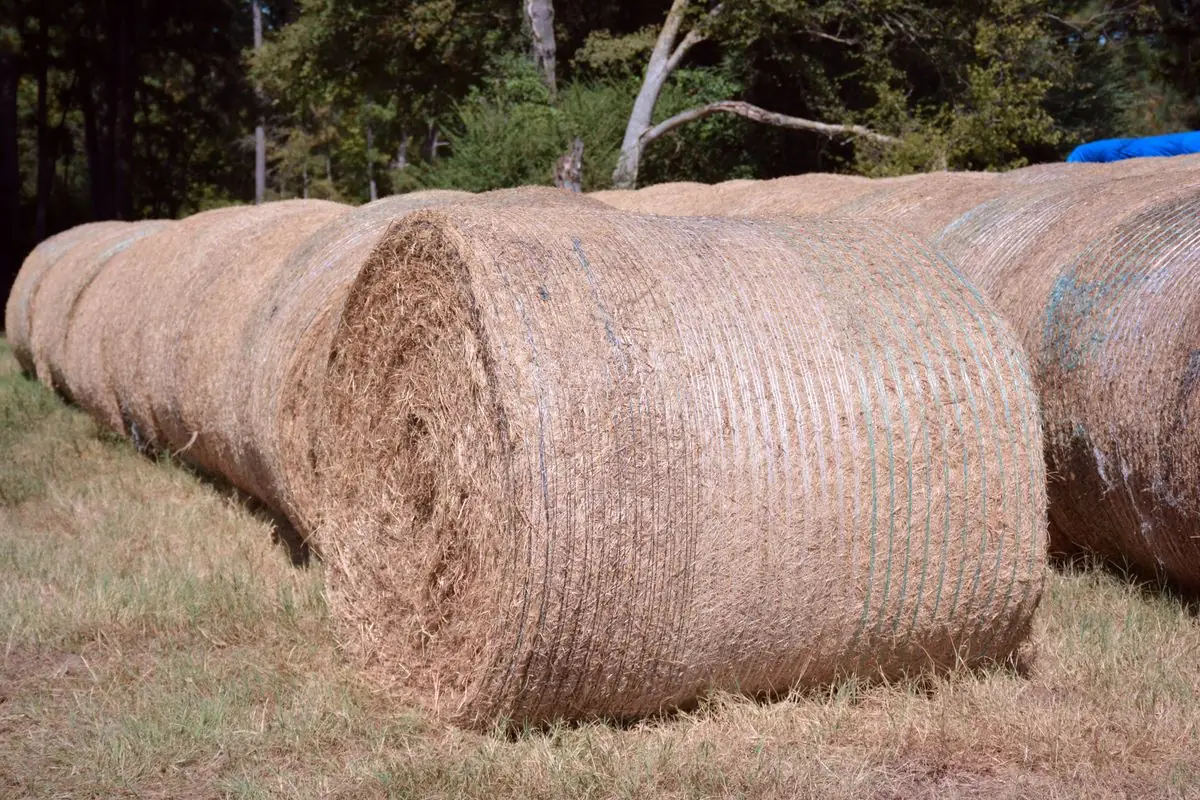
Bales are sold by the bale, but horses eat by the pound — and bale weights vary far more than bale prices suggest. Small square bales commonly weigh about 40 to 60 lb; round bales commonly run from about 800 to 1,200 lb, depending on the baler, the size and how tightly they were packed. Treat those as typical ranges to sanity-check your own bales, not as a promise about yours: the only figure that matters is what a bale from your batch actually weighs. Weigh one — on yard scales or a luggage scale — and enter that weight above. A 10 lb error per bale becomes a whole bale missing by mid-winter.
Waste: the hay you buy but never feed
Not every pound you buy reaches the horse. Hay fed on the ground is trampled, soiled and used as bedding, and horses pick through a bale and refuse the stemmiest parts. Feeding from a net, rack or feeder keeps hay off the ground and slows the picking, so it usually wastes noticeably less than ground feeding — how much less depends on your horse and your set-up, which is why the calculator asks for your own waste percentage rather than assuming one. Ten per cent is a reasonable starting allowance for tidy feeding; generous ground feeding may need more. Watch what is left when the next bale goes out, and adjust.
Worked example: one horse, one month
Take the defaults: one 1,100 lb horse, fed at 2 per cent of body weight for 30 days, from 50 lb small square bales, with a 10 per cent waste allowance.
| Forage per day (1,100 lb × 2%) | 22 lb |
| Days to feed | 30 |
| Total forage (22 lb × 30 days) | 660 lb |
| Waste allowance | 10% |
| Total including waste | 726 lb |
| Bale weight | 50 lb |
| Calculation | 726 ÷ 50 = 14.5 |
| Bales needed (rounded up) | 15 bales |
Fifteen bales a month is the planning figure — and because bales are rounded up, the part bale carries forward rather than leaving the horse short in the last week.
Planning a winter's hay
Multiply the same maths by a season and the stakes become clear. At the worked-example rate — 22 lb a day plus 10 per cent waste — a 150-day winter needs 3,630 lb of hay, about 73 small square bales, for one horse. Buying that before winter, when hay is plentiful, is usually simpler than hunting for bales in February. Count your horses honestly, add the waste you actually see, and order for the longest winter you might get, not the average one: leftover hay keeps, within reason, but a shortfall in a hard month cannot be fixed afterwards.
Storing hay so the plan survives
Hay bought well can still be lost in storage. Keep bales dry and off the ground — on pallets or a dry floor, under a roof or a sound tarp — with air able to move around the stack. Damp hay heats, moulds and becomes feed no horse should eat, and a mouldy bale is a total loss, not a discount. Use hay first in, first out: oldest bales at the front, new deliveries behind them. Check the stack as you take each bale — smell, dust and heat are the early warnings. The Alabama Cooperative Extension's guide to decreasing the costs of feeding horses, including its table of National Research Council requirements, is a sound companion read on feeding efficiently.
Hay is the forage foundation; concentrates and balancers sit on top of it. Size the full ration with our feed calculator, re-check body weight whenever condition changes, and see the sources and assumptions behind both tools on our methodology page.
Horse hay questions
How many bales of hay does a horse need per month?
It depends on the horse's weight, the forage rate and your bale weight. For this page's worked example — a 1,100 lb horse at 2 per cent, from 50 lb bales, with 10 per cent waste — the answer is 15 small square bales a month. Run your own figures above for your horse.
How much hay should a horse eat per day?
Plan on forage at 1.5 to 2.5 per cent of body weight per day on a dry-matter basis, with 2 per cent the common maintenance baseline — 22 lb a day for a 1,100 lb horse. Where your horse sits in the range depends on condition and workload; your vet can help place it.
Are small square bales or round bales better value?
Round bales usually cost less per pound, but they need storage, handling equipment and enough horses eating at once to finish one before it spoils once opened. Small squares cost more per pound yet suit one or two horses: easy to move, portion and store. Compare cost per pound actually fed — after waste — not price per bale.
Can I use this calculator for multiple horses?
Yes — that is what the number of horses field is for. Enter how many horses you are feeding at the weight and rate you set, and every total, including bales, multiplies accordingly. If your horses differ a lot in weight or rate, run it once per group and add the bale totals together.
How long does a round bale last one horse?
Divide the bale's real weight by the horse's daily forage: a 1,000 lb round bale for a horse eating 22 lb a day lasts about 45 days in theory. In practice a bale open that long loses quality and waste rises, so the real answer is shorter — round bales suit groups better than single horses.